21/06/2026
Stolen and Returned: Franco Prodi’s Viola, Crafted by Sesto Rocchi, Comes Home After the Theft
06 apr 2026
What does a musical instrument represent? Many things at once: the choice of raw materials, the craftsmanship of the luthier, the story of the musician—or musicians—who have played it, and the emotional bonds that arise thanks to the instrument itself. A life. Many lives, intertwined. And often, the theft of a musical instrument can shatter in a single instant all the memories that it has silently preserved for years—sometimes even for centuries.
A few days after the theft, the Carabinieri returned to Professor Franco Prodi—brother of the better-known former Prime Minister Romano—his viola: a very special instrument, above all for what it represents.
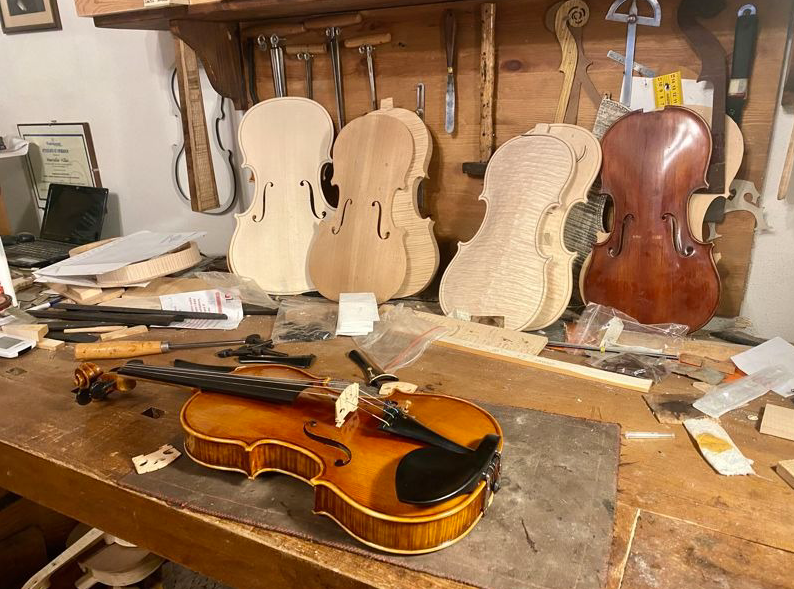
Built in 1964 by the luthier Sesto Rocchi (1909–1991) of San Polo d’Enza, the instrument accompanied Professor Franco Prodi’s musical life for over sixty years. Trained at the School of Violin Making in Parma under Gaetano Sgarabotto and later in Milan at the workshop of Leandro Bisiach, Rocchi crafted numerous instruments in San Polo during his long and distinguished career. In 1980, he was appointed curator of Paganini’s violin, “Il Cannone,” preserved in Genoa.
In 1965, the viola was purchased by the professor with one of his first salaries as a geophysicist working for the Italian Air Force. Over the years, he directed scientific activities in the field of atmospheric physics, which he taught at the University of Ferrara; he also worked at the National Research Council and served as a consultant in the construction of two radar systems in Torchiarolo and Mesagne, near Brindisi Airport.
Alongside his studies in physics, Franco Prodi pursued music with equal dedication. Together with his brother Quintilio—an architect and an excellent cellist—he played regularly. In his free time, Prodi also frequented Sesto Rocchi’s workshop, where he helped refine the instruments made by the master. He was responsible for the final setup of the instruments presented in 1966 at the International Competition in Liège, where Rocchi was awarded first prize—an achievement that confirmed his craftsmanship and placed him among the great European luthiers of the twentieth century.
Rocchi mainly built instruments modeled after Amati, Guarneri, Guadagnini, and Santo Serafino, though his preferred reference was undoubtedly Stradivari, whose models he explored in all their variations. He even produced a copy of the famous Medici quintet and individual instruments such as the “Alard” and the “Messiah.” Through countless experiments, he ultimately identified what he considered the ideal model for both acoustics and stylistic beauty: the Stradivari of 1715.
Franco Prodi not only grew musically in Rocchi’s workshop but also learned there the art of violin making—an art he still cultivates today, building instruments for his grandchildren. It was in that same workshop in San Polo d’Enza that he met Laura, the luthier’s daughter, who would become his wife in 1969. Together, in 2008, they founded the “Sesto Rocchi Festival” in San Polo, now in its nineteenth edition. This year, from August 31 to September 6, under the direction of Antonello Farulli, the festival will celebrate the 80th anniversary of universal suffrage in Italy.
The viola recovered by the Carabinieri and returned to Franco Prodi is therefore not merely “an instrument worth 40,000 euros,” but a musical object rich in history and filled with personal and family memories—memories that a single act of theft could have erased forever.
Fabio Perrone
© Riproduzione riservata